Voters delivered a shift in Washington this week. In Tuesday’s midterm elections, Democrats won control of both the House of Representatives and the Senate. With a Republican in the White House, the next Congress will usher in divided government. What does that mean for investors?
A century of U.S. stock market data suggests that congressional control offers little guidance for investment decisions. The chart below shows the growth of $1 invested in the S&P 500 Index from 1926 through September 2026, with colors indicating which party controlled Congress. The initial $1 grew to $24,200 as stocks advanced through periods of Republican, Democratic, and mixed control. Significant declines occurred under each, too.
The market and U.S. midterm elections
Growth of a $1 investment in S&P 500 Index
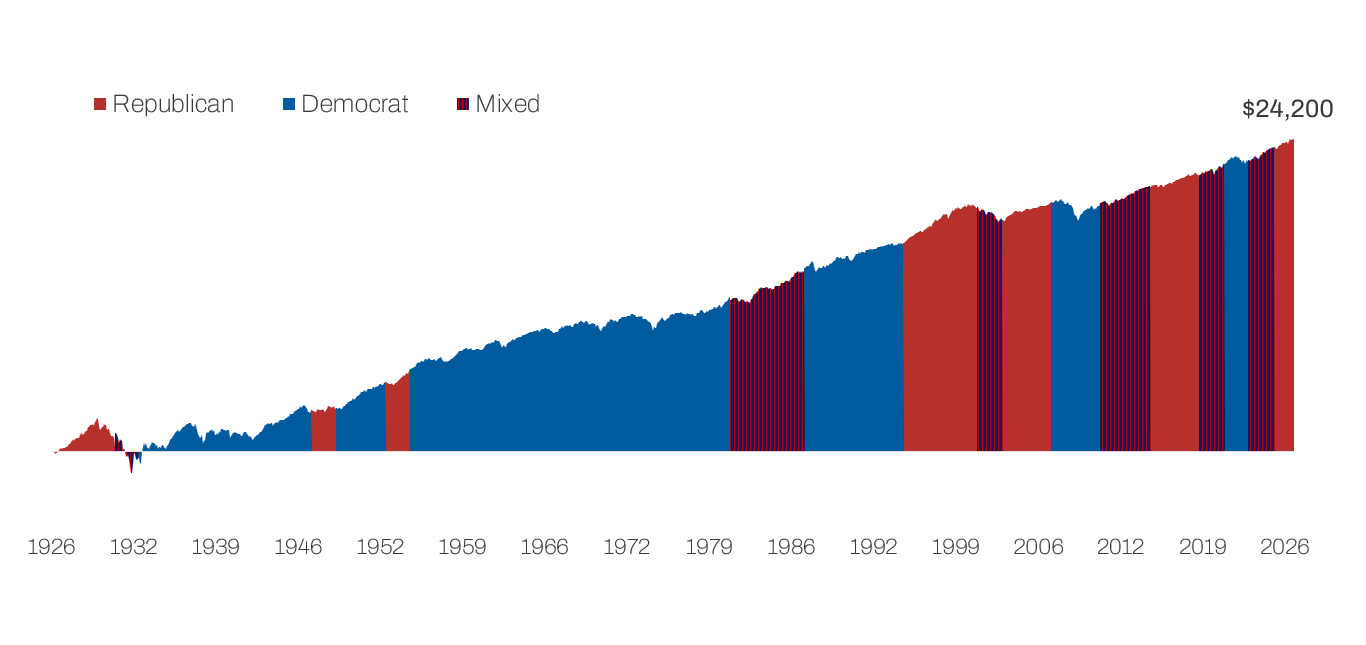
Source: S&P data © 2026 S&P Dow Jones Indices LLC, a division of S&P Global. All rights reserved. Growth of $1 invested in the S&P 500 Index from January 1926 to September 2026. Past performance is not a guarantee of future results. Indices are not available for direct investment; therefore, their performance does not reflect the expenses associated with the management of an actual portfolio.
Interestingly, U.S. stock market returns during election months have historically been higher than those in other months. This can tempt investors to favor sectors expected to benefit from election results. But a 2023 study by Anderson, Białkowski, and Wagner found little evidence that investors could earn superior returns by favoring particular industries around midterms, after accounting for the market’s overall performance.
That doesn’t mean election outcomes are irrelevant to markets. Tax policy, government spending, and regulations matter. But so do interest rates, geopolitical events, technological innovation, and the earnings expectations already reflected in stock prices. Even with the election results now known, their implications for future market returns remain uncertain.
Ultimately, investors own businesses, not political parties. Those businesses will continue serving customers and pursuing profits regardless of who holds power in Washington. Historical evidence suggests staying invested and being diversified is a more reliable approach than adjusting portfolios in anticipation of, or in response to, election results.
