Portal
Let's talk
  • What we do
    • Wealth management services
    • Our approach
    • Working together
  • About us
    • Our team
    • Our company
    • Community engagement
    • News and events
  • Insights
  • Careers
  • Contact us
  • Portal login
  • Disclosures
The latest insights
  • The midterms and your portfolio: what history tells us
  • Separately Managed Accounts: What they are and when they make sense
  • All-time high? Or just another Thursday?

Bond “selloff” headlines miss the big picture

August 27, 2026
Author: Jeremy Wang, CFA

Around the world, long-term government bond yields have climbed to their highest levels in more than a decade, putting downward pressure on bond prices and prompting headlines about a global bond “selloff.” In the U.S., the 30-year Treasury yield recently reached its highest level since 2007.

Persistent inflation concerns and increasing government debt levels may be among many factors contributing to the rise in rates. However, the term “selloff” sounds more dramatic than what the typical Vista client has experienced.

When headlines describe a stock market selloff, investors often think of swift declines of 10% or more. Bond markets generally move much less dramatically. Total return has been roughly flat this year, with the largest drawdown of 4% occurring in February. That’s a much more modest decline than the term “selloff” implies.

That doesn’t mean rising rates are painless. As previously mentioned, when rates rise, bond prices fall. But there is an important silver lining: higher yields today mean higher expected returns for bond investors going forward.

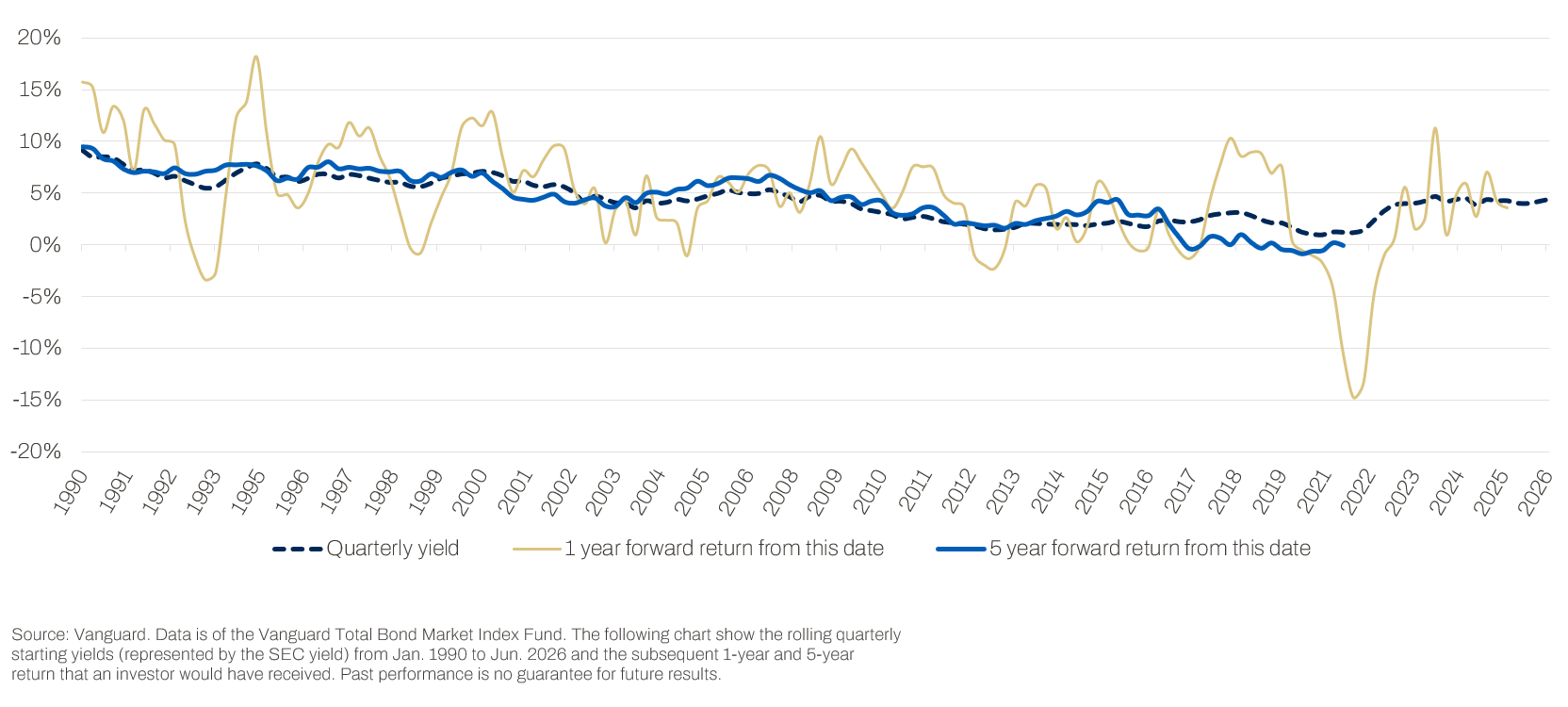
The chart below illustrates this relationship. It shows rolling quarterly yields for the U.S. bond market since 1990, along with its subsequent one- and five-year returns. In the short term, returns can differ substantially from the starting yield as changes in bond prices drive performance. Over longer periods, however, the income earned by the portfolio becomes increasingly important, and returns have historically moved closer to the starting yield.

This is an important tradeoff for bond investors: the initial decline in bond prices may be uncomfortable, but higher yields today lead the way for higher expected returns. In other words, when it comes to rising rates and bonds, there’s short-term pain but long-term gain.

Short-term pain, long-term gain
Examining the relationship between yield and future returns
Jeremy Wang, CFA

Connect with Jeremy


Article tags
Investing

Related articles
Investing

The midterms and your portfolio: what history tells us

November 5, 2026By Alex Canellopoulos, CFA, CFP®

Stocks have advanced under Republican, Democratic, and mixed control of Congress. The evidence favors staying invested and diversified over reacting to elections.

Investing

Separately Managed Accounts: What they are and when they make sense

October 19, 2026By Alex Canellopoulos, CFA, CFP®

Separately managed accounts offer direct ownership of individual securities, which can create added tax-management opportunities for investors whose circumstances warrant it.

Investing

All-time high? Or just another Thursday?

September 11, 2026By Joe Rayburn, CFP®

New market highs can feel unsettling, as if stocks can’t climb any higher. But history shows something different. We look at the data, and why staying the course is key.

Subscribe to agenda-free news, tips, and analysis, delivered to your inbox.

This field is for validation purposes and should be left unchanged.
  • Legal Disclosures
  • Form CRS
  • Client Portal
  • Cookie Policy
  • Legal Disclosures
  • Form CRS
  • Client Portal
  • Cookie Policy
  • Legal Disclosures
  • Form CRS
  • Client Portal
  • Cookie Policy
Contact us
© Vista Capital Partners 2026. 100% employee-owned.
Manage Consent

We use cookies to track website performance. View our Privacy Policy for details.

Functional Always active
The technical storage or access is strictly necessary for the legitimate purpose of enabling the use of a specific service explicitly requested by the subscriber or user, or for the sole purpose of carrying out the transmission of a communication over an electronic communications network.
Preferences
The technical storage or access is necessary for the legitimate purpose of storing preferences that are not requested by the subscriber or user.
Statistics
The technical storage or access that is used exclusively for statistical purposes. The technical storage or access that is used exclusively for anonymous statistical purposes. Without a subpoena, voluntary compliance on the part of your Internet Service Provider, or additional records from a third party, information stored or retrieved for this purpose alone cannot usually be used to identify you.
Marketing
The technical storage or access is required to create user profiles to send advertising, or to track the user on a website or across several websites for similar marketing purposes.
  • Manage options
  • Manage services
  • Manage {vendor_count} vendors
  • Read more about these purposes
View preferences
  • {title}
  • {title}
  • {title}