For most investors, broadly diversified index mutual funds and exchange-traded funds (ETFs) provide an effective way to build diversified, low-cost, and effective portfolios in pursuit of their long-term goals. For certain investors, however, a lesser-known strategy—a Separately Managed Account (SMA)—may be a more appropriate solution.
An SMA is a professionally managed portfolio of individual securities. Unlike a mutual fund, where investors’ dollars are pooled with other shareholders’, an SMA is distinct portfolio where the investor directly owns the underlying securities, not simply shares of a fund.
Direct ownership can create more opportunities for personalized tax management and portfolio customization while still maintaining the appealing characteristics of a mutual fund or ETF.
An SMA is not inherently better than a mutual fund or ETF. It is simply another vehicle which may be more appropriate when an investor’s circumstances warrant it.
More personalized tax management
Tax management is one of the most compelling benefits of an SMA.
Because each security is owned separately, the manager can evaluate individual positions for tax-loss harvesting. A stock that has declined in value relative to its purchase price can be sold to realize a loss, with the proceeds reinvested in other securities to maintain the portfolio’s intended market exposure.
Those losses can be used to offset realized capital gains within the SMA, and also outside of the SMA in the investor’s broader portfolio. This enables an investor to potentially minimize current year taxes, deferring them into the future.
While the potential for tax deferral is not unique to SMAs, they can provide additional opportunities relative to a fund or ETF since losses may be generated even when the overall market has appreciated.
In 2023, for example, the S&P 500 Index gained approximately 26%, yet nearly 40% of its constituent stocks finished the year with negative returns. That year, an investor holding a mutual fund or ETF benchmarked to the S&P 500 Index would have participated in the index’s overall gain, but could not have selectively harvested losses from the 40% of stocks which declined. An SMA may have been able to capture some of those losses, while keeping the portfolio fully invested.
Tax losses are not guaranteed, and the magnitude of losses is highly dependent on future market conditions and the investor’s tax circumstances. Tax-loss harvesting should therefore be viewed as an additional ongoing opportunity to customize a portfolio to an individual investor’s circumstances, not the sole reason to use an SMA.
Tax-loss harvesting opportunities
S&P 500 return vs. percent of stocks with positive and negative returns
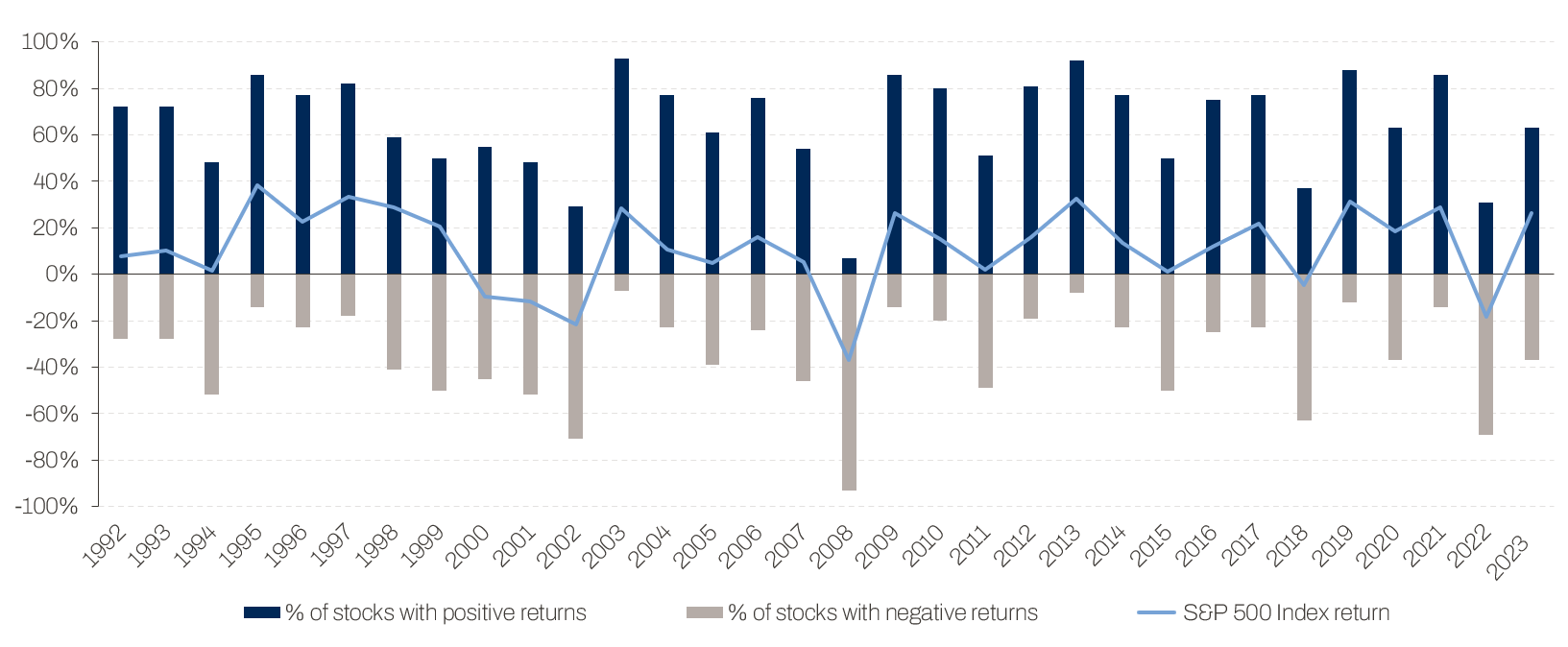
Source: Vanguard and FactSet as of January 31, 2024. Past performance is no guarantee for future results.
When might an SMA make sense?
SMAs generally involve higher investment minimums and the possibility of performing differently from a comparable fund or index. Their tax-management benefits are also only relevant in taxable accounts.
- An SMA may be worth considering for an investor who:
- Has taxable accounts
- Owns highly appreciated individual stocks
- Expect a significant taxable event in the future
- Has specific values or other constraints they’d like reflected in their portfolio
While these are some of the common characteristics of investors who may benefit from an SMA, the decision to use an SMA should only be made after thorough evaluation of an investor’s complete financial picture.
The takeaway
SMAs provide an additional way to implement a diversified, evidence-based investment strategy. Relative to mutual funds and ETFs, their primary distinction is direct ownership of underlying securities, which can create additional opportunities for tax management.
For most investors, low-cost and diversified mutual funds and ETFs are a simple and effective way to gain access to public stock markets. When appropriate, however, an SMA can be an effective complement. The appropriate vehicle is the one that best supports the investor’s goals while preserving diversification, discipline, reasonable costs, and a long-term perspective.
