A persistent myth in fixed income (bond) investing is that buying and holding individual bonds to maturity is better and more certain than investing in a bond fund.
The myth is largely based on the control investors feel knowing that with an individual bond, investors will receive their principal back at maturity, regardless of market volatility, as opposed to the uncertain future price of the basket of bonds that make up a bond fund.
We’ve examined the data and found that the emotional appeal of individual bonds often masks overlooked drawbacks, which lead us to often prefer bond funds.
The appeal of individual bonds
When investing in an individual bond, investors have control: they pick the issuer, know the coupon rate, the maturity date, and the expected cash flows. The predictability of these interest payments and the promise of full principal repayment at maturity creates a sense of security.
There’s also, admittedly, a bit of nostalgia. Individual bonds feel tangible, evoking the days of physical certificates and “clipping coupons.” But comfort isn’t the same as economic value.
The “principal at maturity” myth
Many investors believe holding bonds to maturity protects them from rising interest rates. While it’s true investors get their principal back (barring default), the present value of that principal declines if rates rise.
So, while investors don’t “lose” money in nominal terms, after an interest rate increase, they’re locked into a below-market yield while newly issued bonds offer more. The cost is real, even if it isn’t realized as a capital loss.
The mathematics of bond pricing
Bond markets are efficient. When rates change, bond prices immediately adjust to reflect the new yield environment. Whether an investor sells an old bond and reinvests in a new one, or holds the initial bond to maturity, the economic outcome is the same.
Consider two investors holding bonds before a rate increase:
- Investor A holds the now “low coupon” bond to maturity.
- Investor B sells the bond at a loss and reinvests in a higher yielding one.
Investor A avoids the loss on paper, but earns less income. Investor B realizes the loss but earns more going forward. Accounting for all cash flows, the returns are nearly identical, which is what we’d expect in a well-functioning bond market. The only difference is in the timing.
For most individuals, investing in individual bonds comes with two primary drawbacks:
1. Lack of diversification. A properly diversified bond portfolio typically requires a substantial amount of capital, particularly if the aim is to obtain adequate issuer, sector, and maturity diversification. That can be too capital intensive for most individuals, who we see choosing to hold just a half dozen or so bonds in their portfolio.
Bond funds we favor frequently hold dozens (ex. international bond funds) if not hundreds (ex. state specific) or thousands of bonds (ex. national municipal or treasury) to achieve proper diversification. Clients receive this diversified exposure within a single investment.
2. Opaque costs. While individual bonds often trade in $1,000 increments, small investors face hidden costs in the form of “bid-ask spreads.” This spread is the difference between what the seller receives and the buyer pays and is earned by the facilitating broker.
Bid-ask spreads for individual municipal or corporate bonds can range from 0.1% to 2% of the transaction price, depending on size and liquidity. It’s not uncommon for the purchase (or sale) of a $10,000 bond to incur a 0.8% to 1% spread, a huge markup over what a large, institutional bond fund pays when buying and selling individual bonds.
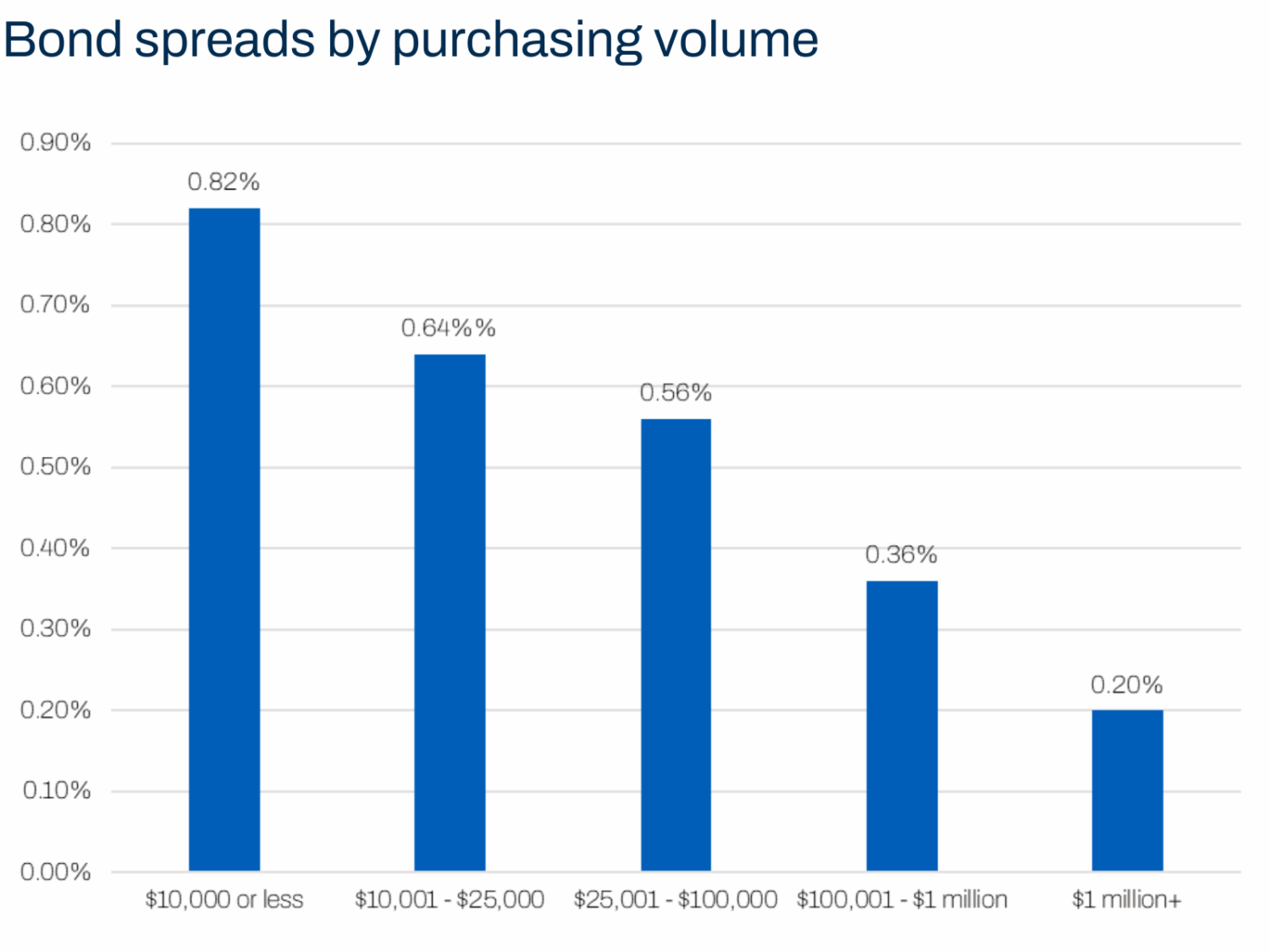
Source: Vanguard. “The ‘principal at maturity’ myth.” https://advisors.vanguard.com/strategies/fixed-income/bonds-vs-bond-funds#yield-to-maturity-myth.
The case for bond funds
With access to bond funds from the likes of Vanguard and Dimensional Fund Advisors, our clients benefit from institutional management, economies of scale, and cost transparency.
While the appeal of individual bonds often stems from an illusion of control, long-run security comes from piggybacking on true economic fundamentals, not nostalgia or emotional comfort.
Diversified bond funds can provide broader exposure, better risk management, and lower costs—all without the illusion of control that comes with owning individual bonds. Clipping coupons and building ladders of individual bonds might have been a popular investing pastime, but today we have access to far more powerful and efficient alternatives.
With bond yields now more attractive than in recent decades, investors may be tempted to return to individual bonds. But unless an investor has the resources to build a massive, well-diversified ladder of individual bonds, they’re likely paying extra for a sense of control that doesn’t translate into earning more.
Like the stock market, the bond market doesn’t often reward comfort or control; it rewards sound economics. And for most investors, that means favoring bond funds.
Related: