Fifty years ago this month, John Bogle introduced the first index mutual fund for individual investors. He hoped to raise $150 million. Investors gave him just $11 million. The press soon dubbed it “Bogle’s Folly.”
The folly, it turned out, was one of the great financial innovations of the past century.
The idea behind indexing was simple: Instead of paying someone to try and pick the right stocks, own all the stocks. Academic research had been pointing investors in this direction for decades. As early as 1933, Alfred Cowles found little evidence that professional investors could reliably outperform the market. Research in subsequent decades concluded the same. So in 1960, researchers Edward Renshaw and Paul Feldstein proposed that someone create a low-cost fund that simply tracked the market.
Bogle accepted the challenge in 1976 by launching the first retail index fund. The goal wasn’t to beat the market; it was that they would stop trying – and by keeping costs and trading to a minimum, allow investors to keep more of the market’s return.
The impact has been massive. Vanguard estimates that indexing has saved investors roughly $570 billion in fees over the past 25 years. Better still, demand for index funds more broadly has helped drive costs down across the fund landscape.
Critics warn that indexing has become too big, distorts prices, or creates bubbles. But there’s an irony here: If indexing is making the market less efficient, active managers should find more opportunities to beat it. But they aren’t. The vast majority of them have underperformed their benchmarks.
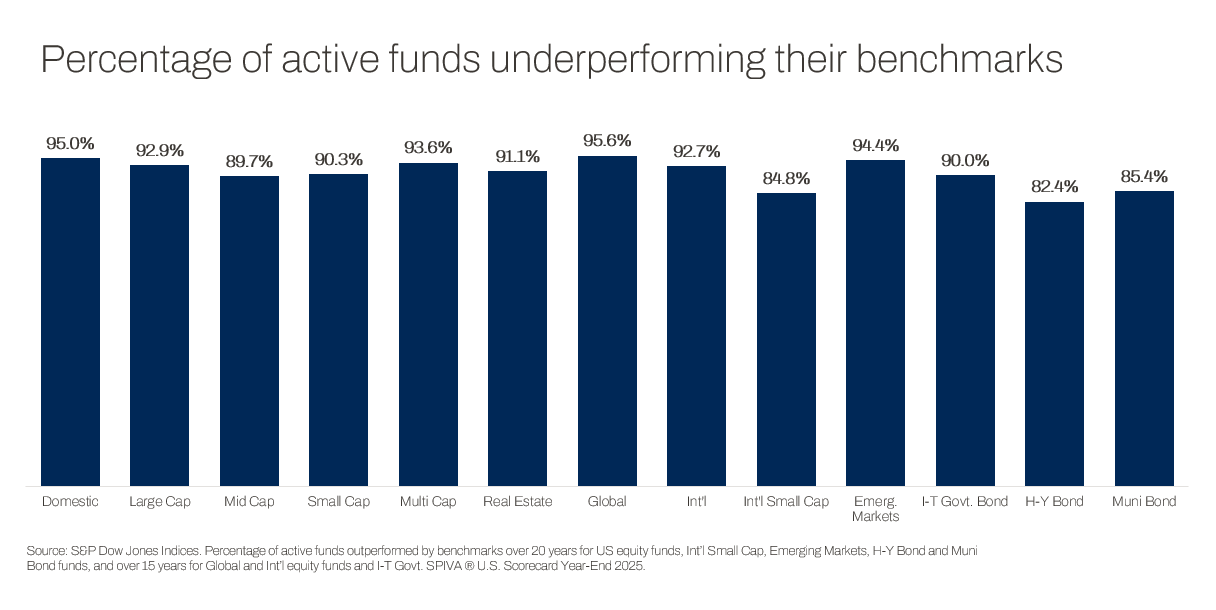
Maybe that’s the index fund’s real legacy. It didn’t make investing more exciting. It made investing cheaper, simpler, and more reliable.
Not bad for a folly.