Portal
Let's talk
  • What we do
    • Wealth management services
    • Our approach
    • Working together
  • About us
    • Our team
    • Our company
    • Community engagement
    • News and events
  • Insights
  • Careers
  • Contact us
  • Portal login
  • Disclosures
The latest insights
  • The midterms and your portfolio: what history tells us
  • Separately Managed Accounts: What they are and when they make sense
  • All-time high? Or just another Thursday?

Will Rising Interest Rates Hurt Stock Prices?

August 18, 2017
Author: Dougal Williams, CFA

Q: Will Rising Interest Rates Hurt Stock Prices?

A: While the future is unknown, historical research has shown that changes in interest rates have been largely unpredictable. Similarly, attempts to get out of markets before stocks fall, and re-enter markets before stocks go up, have not proved fruitful for most investors. Still, many investors want to know what will happen to equity returns if interest rates go up (or down).

Wei Dai, Ph.D., a senior researcher at Dimensional Fund Advisors, recently examined the historical relation between U.S. stock market data and changes in interest rates. Since interest rates for different maturities, for example one-year rates and five-year rates, do not move in lockstep, Dai looked at the relation between stock returns and the Fed Funds rate, as well as 1-, 5- and 10-yr Treasury rates to see if there was a discernable relation between them.

She found none, as the scatter plots below show:
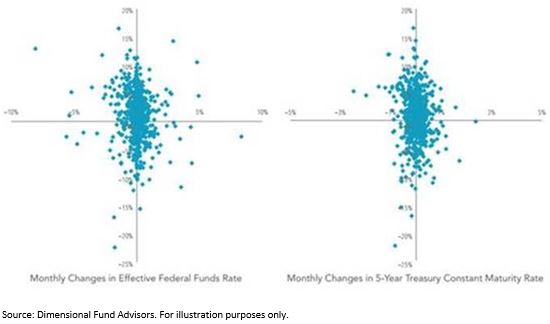
What each of the above two graphs compare is the relation between changes in bond yields, on the horizontal axis, and monthly changes in stock market returns, shown on the vertical axis.

Looking at the Federal Funds Rate as an example (above, left), in months when rates increased, stock returns were as low as -15% and as high as 14%. In months when rates fell, the range of stock returns was from -22% to 16%. The pattern for changes in 5-year Treasury rates was similar.

If changing rates could predict stock returns, we would expect to see a clear pattern in the above charts. Instead, we see a lot of noise clustered around the central axis, or 0%. This means there is no particular direction in the relation between stock returns and interest rate changes.

Instead of seeking to predict the unpredictable, we believe investors are better served by constructing an appropriate mix of stocks and bonds tailored to their long-term goals and objectives, then exercising the discipline to stick with it when it seems uncomfortable to do so.

Dougal Williams, CFA

Connect with Dougal


Article tags
Interest rates

Related articles
Investing

The midterms and your portfolio: what history tells us

November 5, 2026By Alex Canellopoulos, CFA, CFP®

Stocks have advanced under Republican, Democratic, and mixed control of Congress. The evidence favors staying invested and diversified over reacting to elections.

Investing

Separately Managed Accounts: What they are and when they make sense

October 19, 2026By Alex Canellopoulos, CFA, CFP®

Separately managed accounts offer direct ownership of individual securities, which can create added tax-management opportunities for investors whose circumstances warrant it.

Investing

All-time high? Or just another Thursday?

September 11, 2026By Joe Rayburn, CFP®

New market highs can feel unsettling, as if stocks can’t climb any higher. But history shows something different. We look at the data, and why staying the course is key.

Subscribe to agenda-free news, tips, and analysis, delivered to your inbox.

This field is for validation purposes and should be left unchanged.
  • Legal Disclosures
  • Form CRS
  • Client Portal
  • Cookie Policy
  • Legal Disclosures
  • Form CRS
  • Client Portal
  • Cookie Policy
  • Legal Disclosures
  • Form CRS
  • Client Portal
  • Cookie Policy
Contact us
© Vista Capital Partners 2026. 100% employee-owned.
Manage Consent

We use cookies to track website performance. View our Privacy Policy for details.

Functional Always active
The technical storage or access is strictly necessary for the legitimate purpose of enabling the use of a specific service explicitly requested by the subscriber or user, or for the sole purpose of carrying out the transmission of a communication over an electronic communications network.
Preferences
The technical storage or access is necessary for the legitimate purpose of storing preferences that are not requested by the subscriber or user.
Statistics
The technical storage or access that is used exclusively for statistical purposes. The technical storage or access that is used exclusively for anonymous statistical purposes. Without a subpoena, voluntary compliance on the part of your Internet Service Provider, or additional records from a third party, information stored or retrieved for this purpose alone cannot usually be used to identify you.
Marketing
The technical storage or access is required to create user profiles to send advertising, or to track the user on a website or across several websites for similar marketing purposes.
  • Manage options
  • Manage services
  • Manage {vendor_count} vendors
  • Read more about these purposes
View preferences
  • {title}
  • {title}
  • {title}