This month, IBM made headlines on news that customer demand for its artificial intelligence (AI) technology pushed profits above analyst expectations, boosting its stock price to the highest level in years.
The company has long been at the forefront of artificial intelligence, developing the Watson supercomputer which dethroned long-time Jeopardy champion, Ken Jennings, back in 2011.
Since then, of course, AI has had a huge influence on many products and industries and people’s lives—from analyzing satellite images to helping with conservation efforts to, ahem, helping a new generation of college students craft their term papers.
AI technology, however, has not seemed to help investors.
Watson Lags the Market
The AI Powered Equity Exchange-Traded Fund (ETF), launched in 2017, employs IBM Watson’s artificial intelligence to analyze publicly available information in an effort to pick US stocks that will outperform the market.
As shown in the graphic below, the Watson-powered ETF has lagged the broad US stock market and–by a wide margin–the US technology sector since its 2017 inception.
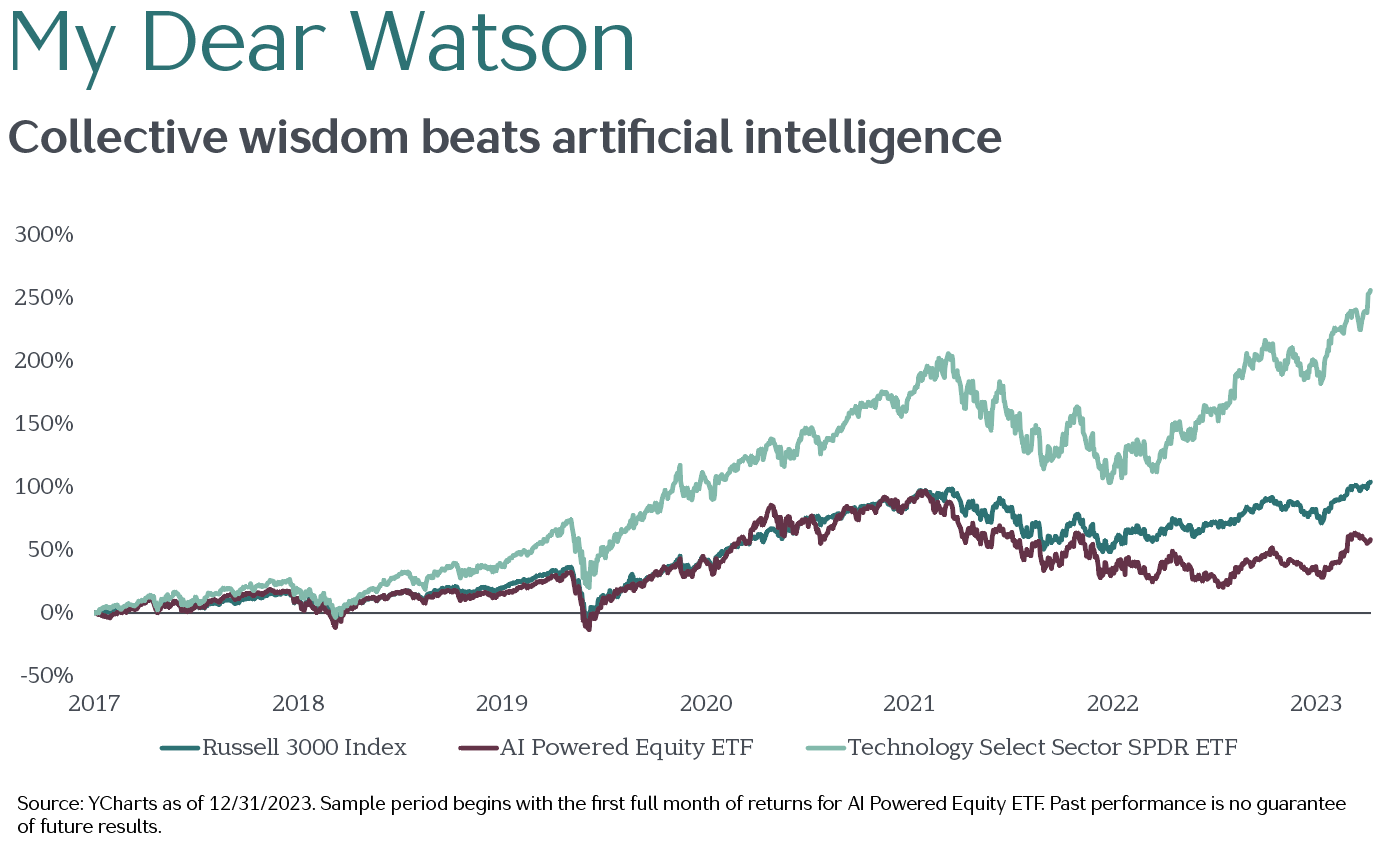
While Watson may be able to outwit even the smartest individual, its intelligence seems to pale in comparison to the aggregate wisdom of the millions of individuals trading (and setting prices) in stock markets each day.
This ETF isn’t the only one to purportedly run on AI.
At least 13 exchange-traded funds have put AI applications in charge of managing their portfolios. Almost all lagged behind the S&P 500 last year.1
Algorithms Aren’t “All That”
So, what’s behind AI’s failure to beat the market?
AI-powered investment strategies seek to leverage AI’s ability to find patterns in massive amounts of data. The AI is “trained” on years of historical information and directed to trade within a given strategy.
While AI can generate potential scenarios based on historical patterns, it may be slow to—or simply unable to–adapt to real world events impacting companies and markets. Would AI have predicted the terrorist attacks on 9/11, the March 2020 start of COVID, or the market’s swift resurgence in the months that followed? That seems unlikely.
We should also remember how market pricing works. Investors with disparate information come together to transact—a buyer and seller—at a price both agree is acceptable. Each party possesses some information, but likely also some “misinformation,” as no investor is all-knowing. When this singular example is multiplied by the nearly $700 billion in global stock market value changing hands each day, most (if not all) of traders’ misinformation would be expected to be cancelled out, resulting in prices which reflect all available information. When “new” news comes out—by definition unpredictable—it is quickly incorporated into market prices, which change in response.
The Fundamentals of Successful Investing
Artificial intelligence may help investors comb through data more quickly and make more informed decisions but acting on that “better” information would only drive security prices closer to their “true” value. This would only further limit the arbitrage opportunities active investors need to outperform market averages.
In a world in which stock prices were even more accurate, piggybacking on the market via low-cost and broadly diversified index funds would be an even better strategy than it is today.
We don’t know what markets have in store in the years ahead—and don’t believe AI can predict it either.
The good news is, successful investing doesn’t require advanced knowledge of the future, but rather adherence to a handful of simple principles:
- Build a plan based on your personal objectives.
- Spread your wealth across a global mix of stocks, bonds, real estate and cash.
- Diversify broadly within each asset class.
- Use low-fee, low-turnover funds to keep a lid on costs and taxes.
- Rebalance whenever a part of your portfolio becomes unwieldly.
For investment success, stick with these basics—and hope for the best from AI.
————-
1 Bob Henderson. “AI Funds Are Missing Out on the AI Stock Boom.” The Wall Street Journal. August 21, 2023. AI Funds Are Missing Out on the AI Stock Boom – WSJ
2 Devin Partida. “How Will Artificial Intelligence Stock Trading Change Finances?” ReHack. May 17, 2021. https://rehack.com/ai/how-will-artificial-intelligence-stock-trading-change-finances
3 David Booth. “Why the Wisdom of the Market Crowd Beats AI.” Dimensional. May 22, 2023. https://www.dimensional.com/us-en/insights/david-booth-in-the-financial-times-why-the-wisdom-of-the-market-crowd-beats-ai