Portal
Let's talk
  • What we do
    • Wealth management services
    • Our approach
    • Working together
  • About us
    • Our team
    • Our company
    • Community engagement
    • News and events
  • Insights
  • Careers
  • Contact us
  • Portal login
  • Disclosures
The latest insights
  • The midterms and your portfolio: what history tells us
  • Separately Managed Accounts: What they are and when they make sense
  • All-time high? Or just another Thursday?

The Cost of Behavioral Bias in Investing

September 16, 2024
Author: Mark Jacobs

This summer, I worked as an intern for Vista Capital Partners and am honored to have been hired as a Client Service Associate. Over the past few months, I did a lot of listening and reading. I learned that successful investing doesn’t have to be so complicated…or so stressful.

Financial headlines – from warnings about “imminent” market crashes, all the way to prophecies of the ‘next big stock’ – we’ve seen them all. But how can an investor keep afloat in this sea of uncertainty?

The answer to this question starts with an understanding of why these headlines are so good at influencing investor decisions. This is where behavioral finance takes center stage. Behavioral finance explores how psychological biases and emotions influence investors’ decisions and how these insights can guide more disciplined and effective investing.

Oftentimes, these biases lead investors to make decisions that aren’t always in their best interest. Here are a few key biases to be aware of:

Confirmation Bias: Tendency to seek out information that supports our existing beliefs and ignore contradictory evidence.

Overconfidence: Overestimating our own knowledge and abilities, leading to riskier decisions.

Herd Behavior: Following the crowd rather than making independent, informed choices, often resulting in impulsive actions.

Anchoring: Relying too heavily on the first piece of information we receive, which can skew our perception of value.

The last key bias to be aware of – and the highlight of this article – is loss aversion. Loss aversion is the tendency to fear losses more than we value gains, often leading to irrational decisions like selling investments in a downturn to avoid perceived losses.

To understand how damaging loss aversion can be to a portfolio, let’s look at the example below:
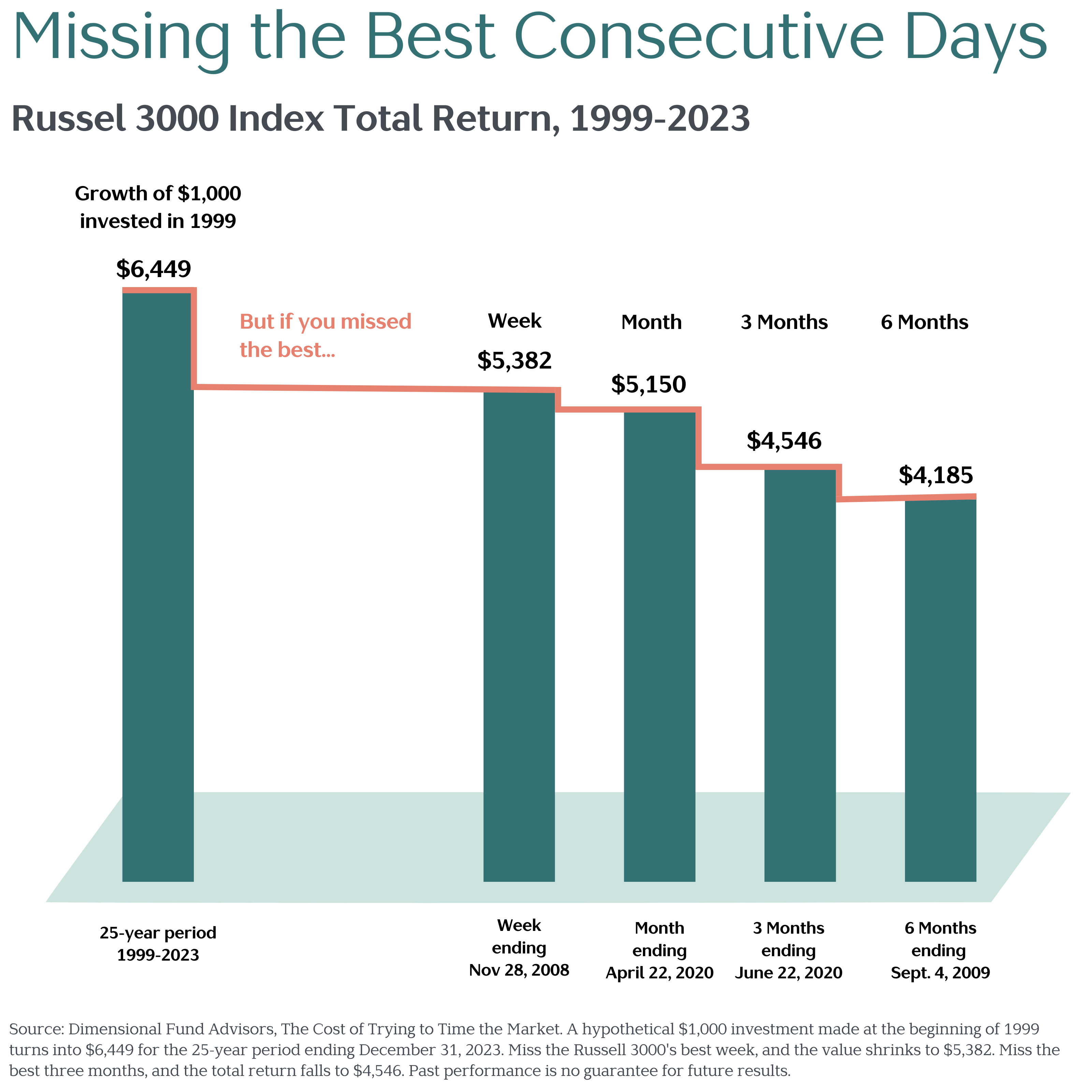
In the figure above, we can see that if someone invested $1,000 in 1999 and didn’t take out that investment until 2023, that $1,000 would have turned into $6,449. However, if the same investor missed the best 6 months of performance by getting out of the market, that $1,000 would have grown to just $4,185.

Discipline Is Key

History has shown the best way to avoid these biases is by having a well-formulated plan and sticking with it. A disciplined approach – making decisions based on evidence, not emotions—provides investors their best chance of success.

Mark Jacobs

Article tags
Investor behavior

Related articles
Investing

The midterms and your portfolio: what history tells us

November 5, 2026By Alex Canellopoulos, CFA, CFP®

Stocks have advanced under Republican, Democratic, and mixed control of Congress. The evidence favors staying invested and diversified over reacting to elections.

Investing

Separately Managed Accounts: What they are and when they make sense

October 19, 2026By Alex Canellopoulos, CFA, CFP®

Separately managed accounts offer direct ownership of individual securities, which can create added tax-management opportunities for investors whose circumstances warrant it.

Investing

All-time high? Or just another Thursday?

September 11, 2026By Joe Rayburn, CFP®

New market highs can feel unsettling, as if stocks can’t climb any higher. But history shows something different. We look at the data, and why staying the course is key.

Subscribe to agenda-free news, tips, and analysis, delivered to your inbox.

This field is for validation purposes and should be left unchanged.
  • Legal Disclosures
  • Form CRS
  • Client Portal
  • Cookie Policy
  • Legal Disclosures
  • Form CRS
  • Client Portal
  • Cookie Policy
  • Legal Disclosures
  • Form CRS
  • Client Portal
  • Cookie Policy
Contact us
© Vista Capital Partners 2026. 100% employee-owned.
Manage Consent

We use cookies to track website performance. View our Privacy Policy for details.

Functional Always active
The technical storage or access is strictly necessary for the legitimate purpose of enabling the use of a specific service explicitly requested by the subscriber or user, or for the sole purpose of carrying out the transmission of a communication over an electronic communications network.
Preferences
The technical storage or access is necessary for the legitimate purpose of storing preferences that are not requested by the subscriber or user.
Statistics
The technical storage or access that is used exclusively for statistical purposes. The technical storage or access that is used exclusively for anonymous statistical purposes. Without a subpoena, voluntary compliance on the part of your Internet Service Provider, or additional records from a third party, information stored or retrieved for this purpose alone cannot usually be used to identify you.
Marketing
The technical storage or access is required to create user profiles to send advertising, or to track the user on a website or across several websites for similar marketing purposes.
  • Manage options
  • Manage services
  • Manage {vendor_count} vendors
  • Read more about these purposes
View preferences
  • {title}
  • {title}
  • {title}