Portal
Let's talk
  • What we do
    • Wealth management services
    • Our approach
    • Working together
  • About us
    • Our team
    • Our company
    • Community engagement
    • News and events
  • Insights
  • Careers
  • Contact us
  • Portal login
  • Disclosures
The latest insights
  • The midterms and your portfolio: what history tells us
  • Separately Managed Accounts: What they are and when they make sense
  • All-time high? Or just another Thursday?

Retirement Spending—Living For Today, Planning For Tomorrow

January 10, 2017
Author: Vista Capital Partners

Retiring requires a fundamental shift from saving to spending mode.  Many retirees report this transition is harder than they expected. After decades of feeding their nest egg, it seems unnatural to stop. Even worse, tapping into their savings feels like breaking a cardinal rule.

It is the details of retirement spending, however, which prove most daunting of all. Vista assists clients with this challenge by establishing sustainable withdrawal plans. Using our own, in-house planning tool, we reconcile a client’s assets, time horizon, expenses (fixed and variable) and income sources.

By running through various iterations of historical market returns and inflation rates, we can assess the viability of a plan under a wide range of real-world conditions.

This exercise involves balancing today’s needs and wants with those of future years.  Spending too aggressively early on can jeopardize long-term financial independence.  Spending too conservatively may unnecessarily lower quality-of-life and lead to later regret (“we could have spent more!”).

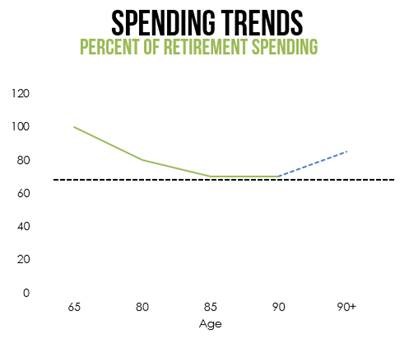
Results of a study conducted by David Blanchett of Morningstar offer useful insights for striking a healthy balance. Blanchett found that retirees who spend $100,000 annually report a 20 percent decline in spending from age 65 to age 80. By age 85, spending is reduced an additional 10 percent. These reductions in total spending are due to decreased expenditures on travel, dining out, and mortgage payments which more than offset the increase in healthcare expenses.

This means it can be possible to spend more at the outset of retirement, provided a retiree is willing and able to reduce spending in the future. Vista’s anecdotal evidence from working with retired clients for the past 16 years is remarkably similar—our clients’ spending tends to decline as they enter and progress through retirement.


hihi


A word of caution: spending more today does require a healthy dose of discipline and commitment. Clients who become accustomed to increased spending may be reluctant to ratchet back in later years. Blanchett’s study indicates that beyond age 85 is when the potential for increased health expenses is likely to occur. It is at this point that adjustments in spending habits will most likely be necessary. To what extent, however, no one can predict (represented by the dotted blue line in the graph above).

The benefit of researching retirement spending is the ability to apply more substance behind the anecdotal evidence we have acquired. Because spending can decrease in retirement by as much as 30 percent, we can adapt our approach to retirement modeling to enhance our clients’ lifestyle today, while ensuring their personal retirement well doesn’t run dry.


Article tags
Retirement

Related articles
Financial planning

Investing in a career: the expanding role of the 529 college savings plan

August 27, 2026By Whit Peters

529 plans now cover more than college — trade school, apprenticeships, grad school, and professional credentials. See how the flexibility can play out in practice.

Financial planning

529 plans turn 30: still the smartest way to save for college

June 19, 2026By Rob Greenman, CFP®

Tax-free growth and consistent contributions can turn into significant college savings.

Financial planning

What The “One Big Beautiful Bill Act” Means For You

ArticleNovember 24, 2025By Jon Gannon, CFP®

This past summer, Congress passed the One Big Beautiful Bill Act (OBBBA)—an ambitious name for a law that brings something surprisingly practical: stability.

Subscribe to agenda-free news, tips, and analysis, delivered to your inbox.

This field is for validation purposes and should be left unchanged.
  • Legal Disclosures
  • Form CRS
  • Client Portal
  • Cookie Policy
  • Legal Disclosures
  • Form CRS
  • Client Portal
  • Cookie Policy
  • Legal Disclosures
  • Form CRS
  • Client Portal
  • Cookie Policy
Contact us
© Vista Capital Partners 2026. 100% employee-owned.
Manage Consent

We use cookies to track website performance. View our Privacy Policy for details.

Functional Always active
The technical storage or access is strictly necessary for the legitimate purpose of enabling the use of a specific service explicitly requested by the subscriber or user, or for the sole purpose of carrying out the transmission of a communication over an electronic communications network.
Preferences
The technical storage or access is necessary for the legitimate purpose of storing preferences that are not requested by the subscriber or user.
Statistics
The technical storage or access that is used exclusively for statistical purposes. The technical storage or access that is used exclusively for anonymous statistical purposes. Without a subpoena, voluntary compliance on the part of your Internet Service Provider, or additional records from a third party, information stored or retrieved for this purpose alone cannot usually be used to identify you.
Marketing
The technical storage or access is required to create user profiles to send advertising, or to track the user on a website or across several websites for similar marketing purposes.
  • Manage options
  • Manage services
  • Manage {vendor_count} vendors
  • Read more about these purposes
View preferences
  • {title}
  • {title}
  • {title}