
With only a few days to go until Election Day, this election year is already shaping up as a bit more unusual than most.
Incumbent President Biden exited the race and Vice President Kamala Harris became the Democratic nominee. There was an assassination attempt on former President Trump’s life. Pundits expect an “epic wave” of retirements in Congress. A host of issues — economic inequality, immigration policy, and access to healthcare–are likely to command voters’ attention as election day draws closer.
An additional question voters often ask is: “How much will the election impact the stock market and, ultimately, my investments?” It may be reassuring to know this question arises even in the most humdrum of election seasons—and that history tells us the answer is not as much as you might think.
Markets Don’t Follow Party Lines
It’s natural for investors to look for a connection between who’s in charge of our country and stock market performance. But nearly a century of data tells a different story. From 1926 to 2023, the U.S. stock market, as measured by the S&P 500 Index, has enjoyed an upward trajectory despite a fairly even split between Democrats and Republicans in the White House.
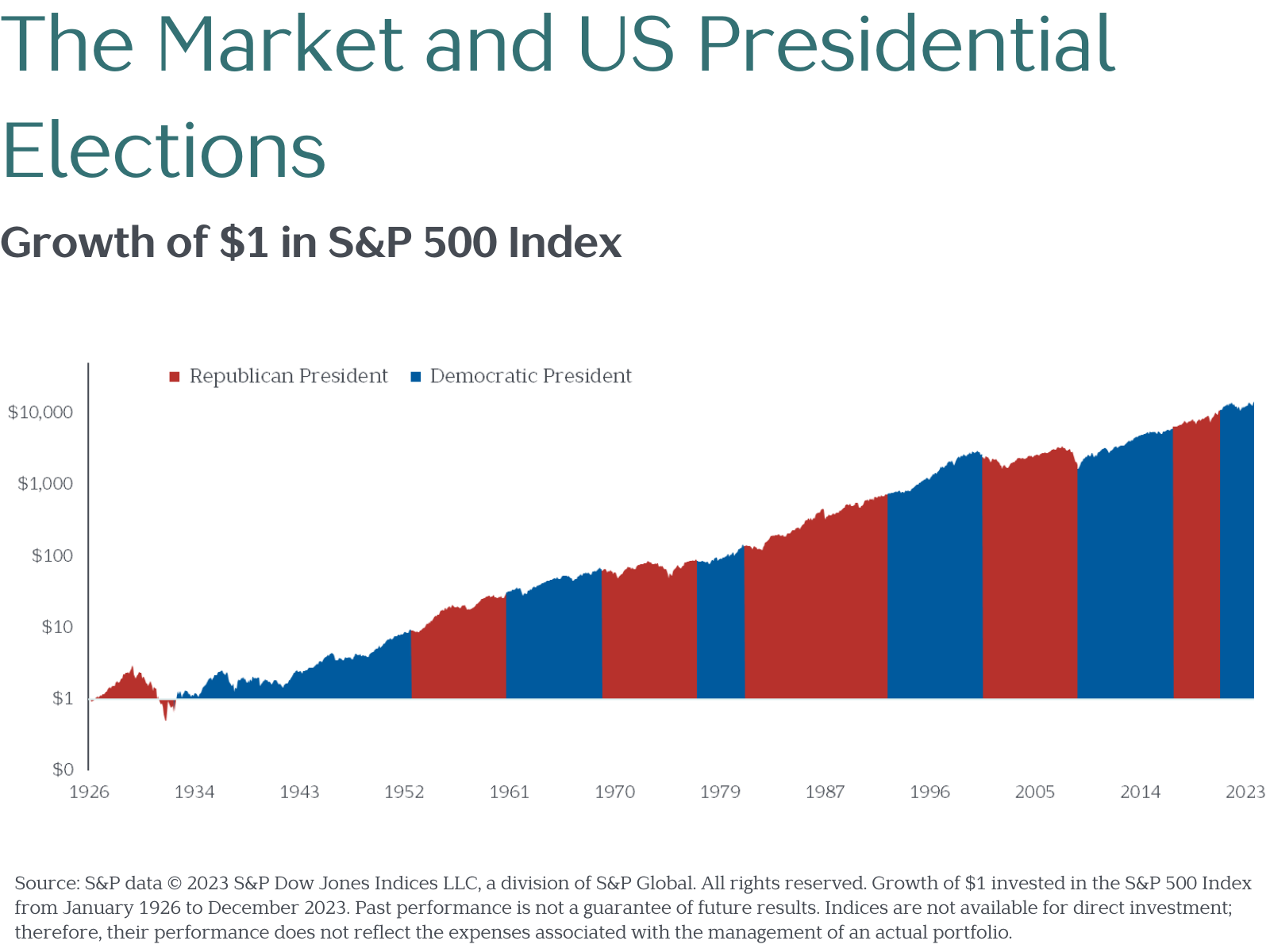
It may just be that sitting presidents don’t have as much influence on economies or markets as they often claim (or deny, depending on the economic climate). This isn’t to say they have no effect; after all, presidents appoint policymakers, set the tone for foreign relations, and sign or veto bills into law. But our checks-and-balances system dilutes a president’s direct impact on how our economy and markets perform.
Second, companies are focused on serving their customers and growing their businesses, regardless of who is in the White House. The motivation to profitably provide goods and services to the world’s growing population transcends administrations. U.S. presidents may have some impact on market returns, but so do many other factors—the actions of foreign leaders, interest rates, changing oil prices, starting market valuations, and technological advances, to name a few.
Busting Common Myths
It’s easy to fall prey to the myth that stock markets move based on election results. That’s what the headlines would have us believe, anyway.
Many myths have taken root because politicians and pundits make both promises and predictions—and they often state them as fact. However, we can dispel these myths by examining recent data. For example:
- Myth: Financial publications accurately forecast future market performance. The truth is that analysts and editors at publications don’t have a crystal ball. Many of them predicted a drop in the stock market in the days immediately following the 2016 election. Instead, markets experienced a significant jump.
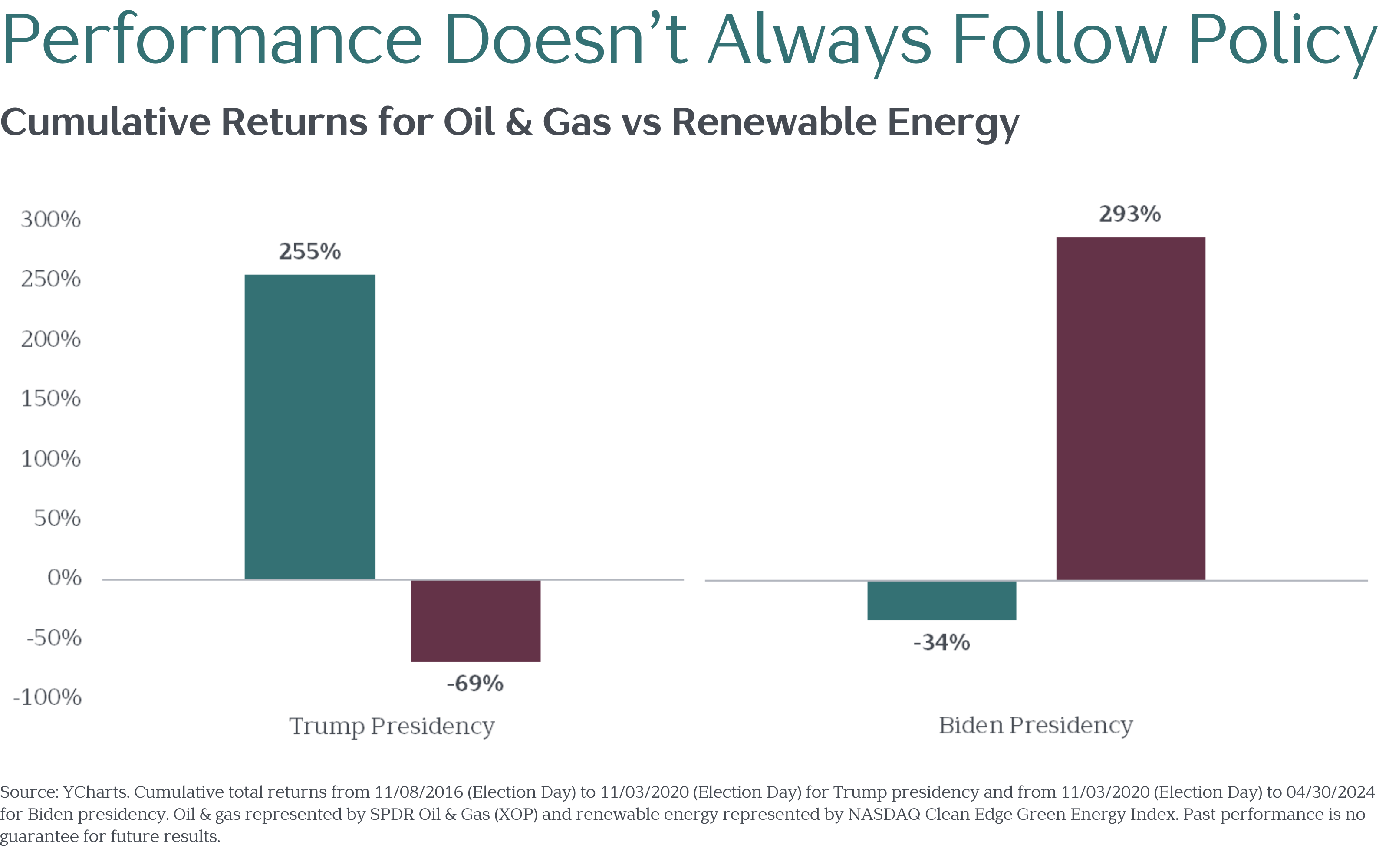
- Myth: Certain sectors always thrive under one party’s policies. Sector performance can rise or fall no matter which party is in the White House. Democrats tend toward favorable renewable energy policies, while Republicans lean toward support for the oil and gas industry. Yet performance of the oil and gas sector declined under Trump and rose during the Biden administration.
- Myth: Volatility increases in the months leading up to an election. Although it may certainly feel that way, the data doesn’t agree. A Vanguard study of presidential elections 1984 and 2020 showed that fluctuations in the market are similar in the days before the election to any other time. Vanguard’s research also indicated that returns during presidential election years and non-election years are statistically indistinguishable.
Hail to Investing Basics
The takeaway?
Election results should not dictate your investment decisions.
Our elected officials have some influence on market performance, as they determine policy, establish regulations, and appoint economic decision-makers. However, politicians and policies are only two factors among a host of factors affecting market performance.
Markets don’t reward investors for electing the “correct” political party. Instead, markets are expected to reward investors for taking risk and exhibiting discipline and patience over time.
———-
Editor’s Note: This post was originally published in June 2024. We have updated the content to reflect changes following Biden’s exit from the presidential election.
