Portal
Let's talk
  • What we do
    • Wealth management services
    • Our approach
    • Working together
  • About us
    • Our team
    • Our company
    • Community engagement
    • News and events
  • Insights
  • Careers
  • Contact us
  • Portal login
  • Disclosures
The latest insights
  • The midterms and your portfolio: what history tells us
  • Separately Managed Accounts: What they are and when they make sense
  • All-time high? Or just another Thursday?

Past Winners Still Don’t Repeat

November 20, 2017
Author: Doug Post, CFP®

Most active investment managers don’t achieve their main objective—delivering higher returns than market averages. In fact, roughly 90% of US, international, and emerging market mutual funds underperformed their respective benchmarks over the past 15 years.

But that doesn’t stop investors from trying. To find the next “market-beating” fund, many turn to the small list of recent “winners.” Unfortunately, past performance has proven to be a poor predictor of future success in active investing. A new study from The Vanguard Group highlights what we’ve long said—past winners don’t repeat.

Using Morningstar’s mutual fund database, Vanguard analyzed the most recent five-year performance (from 2012 to 2016) of all the actively managed stock mutual funds that performed in the top quintile over the previous five-year period in the U.S. (from 2007 to 2011). Vanguard then ranked funds by performance quintiles, or five equal groups of 20%, to once again answer the question—do winners repeat?
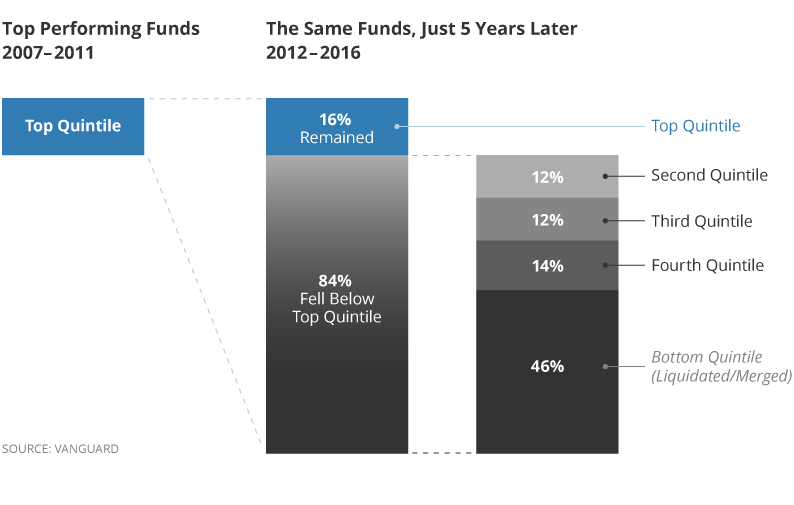


The graphic above displays Vanguard’s findings. Of the winning funds from 2007 to 2011, just 16% remained in the top 20% in the subsequent five-year period. In a result suggestive of pure randomness, an almost equal number of funds fell to the 2nd quintile, 3rd quintile and 4th quintiles, respectively, of the performance rankings. Notably, 21% of past winners fell to the bottom of the performance rankings, while 25% went out of business (“liquidated/merged”).

In other words, past winners were more than twice as likely to fall to the bottom in the next period or go out of business altogether than to remain top performers.

The results of Vanguard’s research reaffirm the well-documented lack of consistent performance among actively managed funds. An earlier and separate review of the best twenty U.S. stock funds during the 1983-1993 decade, for example, found that sixteen failed to even match the index benchmark (much less outperform) in the subsequent ten years. Ten years might seem long enough to deduce that winning managers had above-average skill, but no, 80% of the winners from one decade became losers in the subsequent decade!

Remarkably, such long odds don’t stop investors from trying to outperform the market. Vanguard estimates that 85% of the global equity market—and more than 95% of the global bond market—is still actively managed in an attempt to beat itself.

But the tide is turning. More than $255 billion poured into The Vanguard Group’s index mutual funds in 2016, a clear sign of the shift away from money managers who try to handpick winners.

When it comes to active investing, we know past performance isn’t a good predictor of future results. It is precisely why index funds have anchored our portfolios since first opening our doors in 2001, allowing us to control those few factors we can in an ever-uncertain investment world.

""
Doug Post, CFP®

Connect with Doug


Article tags
Active vs. passive

Related articles
Investing

The midterms and your portfolio: what history tells us

November 5, 2026By Alex Canellopoulos, CFA, CFP®

Stocks have advanced under Republican, Democratic, and mixed control of Congress. The evidence favors staying invested and diversified over reacting to elections.

Investing

Separately Managed Accounts: What they are and when they make sense

October 19, 2026By Alex Canellopoulos, CFA, CFP®

Separately managed accounts offer direct ownership of individual securities, which can create added tax-management opportunities for investors whose circumstances warrant it.

Investing

All-time high? Or just another Thursday?

September 11, 2026By Joe Rayburn, CFP®

New market highs can feel unsettling, as if stocks can’t climb any higher. But history shows something different. We look at the data, and why staying the course is key.

Subscribe to agenda-free news, tips, and analysis, delivered to your inbox.

This field is for validation purposes and should be left unchanged.
  • Legal Disclosures
  • Form CRS
  • Client Portal
  • Cookie Policy
  • Legal Disclosures
  • Form CRS
  • Client Portal
  • Cookie Policy
  • Legal Disclosures
  • Form CRS
  • Client Portal
  • Cookie Policy
Contact us
© Vista Capital Partners 2026. 100% employee-owned.
Manage Consent

We use cookies to track website performance. View our Privacy Policy for details.

Functional Always active
The technical storage or access is strictly necessary for the legitimate purpose of enabling the use of a specific service explicitly requested by the subscriber or user, or for the sole purpose of carrying out the transmission of a communication over an electronic communications network.
Preferences
The technical storage or access is necessary for the legitimate purpose of storing preferences that are not requested by the subscriber or user.
Statistics
The technical storage or access that is used exclusively for statistical purposes. The technical storage or access that is used exclusively for anonymous statistical purposes. Without a subpoena, voluntary compliance on the part of your Internet Service Provider, or additional records from a third party, information stored or retrieved for this purpose alone cannot usually be used to identify you.
Marketing
The technical storage or access is required to create user profiles to send advertising, or to track the user on a website or across several websites for similar marketing purposes.
  • Manage options
  • Manage services
  • Manage {vendor_count} vendors
  • Read more about these purposes
View preferences
  • {title}
  • {title}
  • {title}