Escalating violence in the Middle East has increased market volatility in recent weeks. Stock prices around the world have moved lower, raising questions about the long-term impact on portfolios.
While events like these are serious and unsettling, history provides helpful perspective.
Over the past century, investors have faced wars, geopolitical crises, and energy shocks. These events often lead to sharp, short-term volatility as new information is quickly reflected in prices. But they have not affected the long-term direction of financial markets, as illustrated by the chart below (click here for a larger image).
Military conflicts and market returns
Growth of $1 in U.S. stocks since 1926
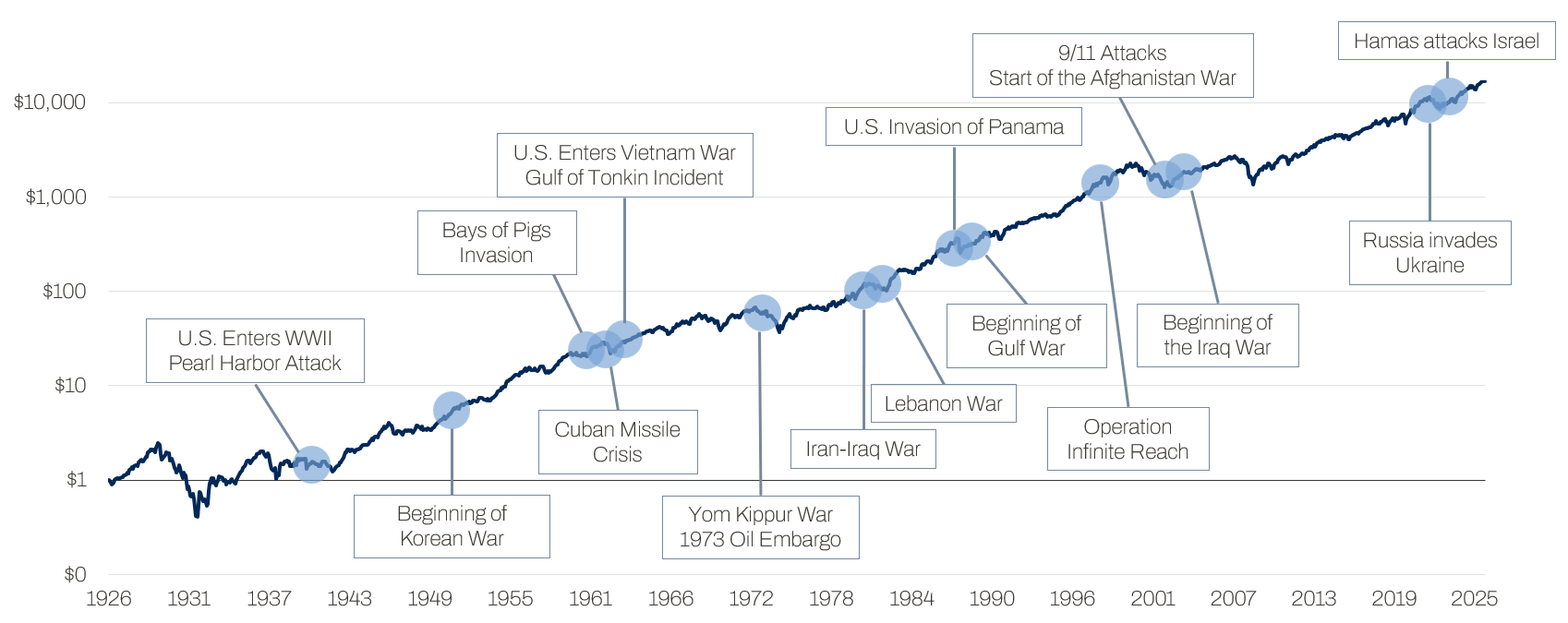
Source: Vista Capital Partners and CRSP. Returns are measured based on the CRSP Deciles 1-10 Index (Market). Data from 1926 to 2025. Past performance is no guarantee of future results.
Research examining U.S. and international stock returns following major geopolitical events highlights this resilience. Looking at the three months, one year, and three years after many of these events, positive returns have been far more common than negative ones.
Individual examples reinforce this pattern. During the Cuban Missile Crisis in 1962, U.S. stocks fell amid rising tensions but fully recovered within months. Similarly, markets declined in the early stages of the Gulf War before rebounding as uncertainty began to ease.
None of this diminishes the seriousness of global conflicts or their human consequences. But for investors, history is clear: reacting to geopolitical headlines by making major portfolio changes is unwise. Staying invested, diversified, and committed to a long-term plan has been the more reliable course of action.
