Portal
Let's talk
  • What we do
    • Wealth management services
    • Our approach
    • Working together
  • About us
    • Our team
    • Our company
    • Community engagement
    • News and events
  • Insights
  • Careers
  • Contact us
  • Portal login
  • Disclosures
The latest insights
  • The midterms and your portfolio: what history tells us
  • Separately Managed Accounts: What they are and when they make sense
  • All-time high? Or just another Thursday?

Dealing With an “Uncertain Market”

March 18, 2016
Author: Dougal Williams, CFA

It’s getting hard to avoid this “uncertain market.”

Every time we listen to the radio, watch TV or open our email, it seems we’re bombarded with ways to “protect ourselves from the volatile market.” Clearly, the Wall Street marketing machine has kicked into high gear, promoting the latest in whiz-bang financial products promising stability amidst uncertainty.

There’s just one problem: The market today is no more uncertain than it’s ever been.

While we’re only six full years into this decade, volatility—one measure of uncertainty—has been mild relative to history.

The graphic below displays the annualized returns of large company U.S. stocks, by decade, along with the accompanying standard deviation (volatility) of those returns. Stock volatility from 2010 through 2015, at just over 13%, was lower than all but only two previous decades in history. (Remember, for any level of return, a lower standard deviation is better.)
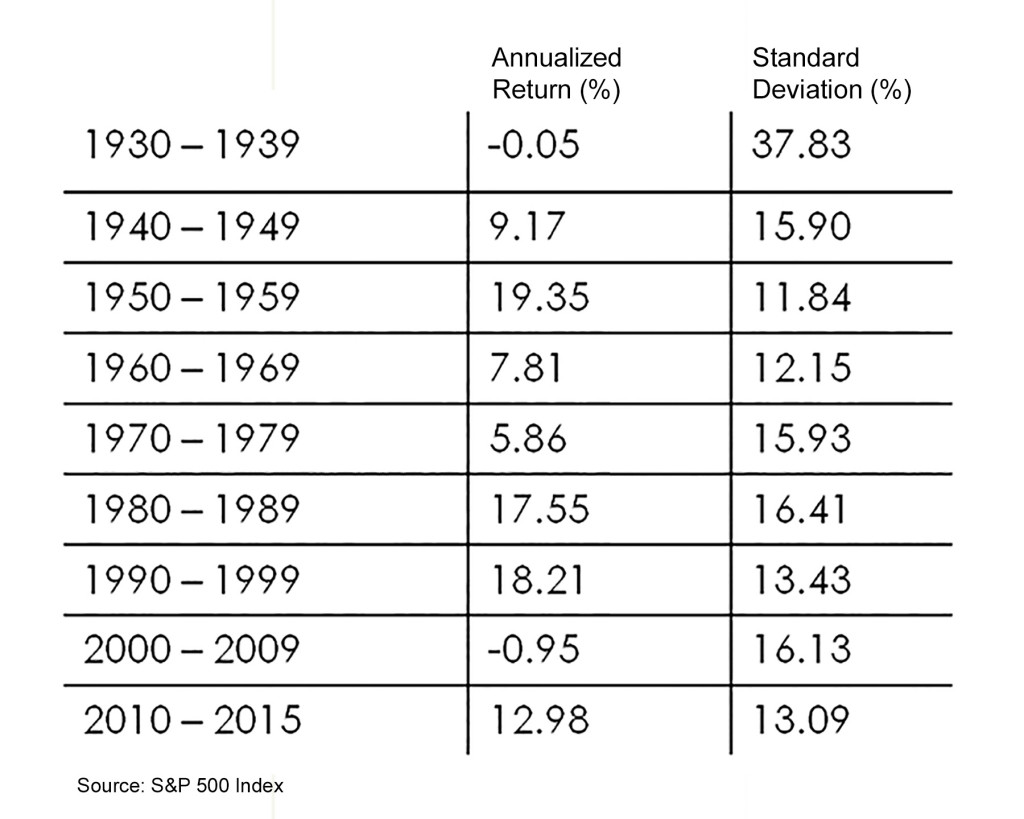
We think a discussion of whether markets today are more or less certain than those of the past risks missing the more important point: Volatility is exactly what we should expect in well-functioning capital markets, as investors digest and act upon new (and often conflicting) information. Uncertainty is part of investing, and the chance to earn a commensurate return is the reward for bearing such risk.

Let’s pretend for a moment, however, markets are more volatile than normal. What’s the appropriate strategy? In promoting the latest “low volatility” product creation, Wall Street implicitly yells “do something!” when a review of the evidence suggests a smarter approach is to stay disciplined and simply do nothing.

In 2015, plunging oil prices and shock waves from China both contributed to stock volatility. Yet, 75% of actively-managed U.S. stock mutual funds underperformed the buy-and-hold investor who was content to simply buy a share of American business, sit back and relax.1

A turbulent year for the bond market, highlighted by the first Fed rate increase in years, proved not to be an environment for active bond managers to shine, either.2 Of the actively-managed funds seeking to outperform a broad basket of intermediate-term bonds, 93% failed to do so.

Results like these suggest, yet again, the best way to deal with uncertainty is to focus on those few factors within our control—our asset mix, the costs we pay and the taxes we face. Oh, yes, and our ability to remain disciplined amidst all the noise.
_________________________
1, 2 S&P Dow Jones Indices. SPIVA ® U.S. Scorecard, Year-end 2015.

Dougal Williams, CFA

Connect with Dougal


Article tags
Economy and marketsMarket timing

Related articles
Investing

The midterms and your portfolio: what history tells us

November 5, 2026By Alex Canellopoulos, CFA, CFP®

Stocks have advanced under Republican, Democratic, and mixed control of Congress. The evidence favors staying invested and diversified over reacting to elections.

Investing

Separately Managed Accounts: What they are and when they make sense

October 19, 2026By Alex Canellopoulos, CFA, CFP®

Separately managed accounts offer direct ownership of individual securities, which can create added tax-management opportunities for investors whose circumstances warrant it.

Investing

All-time high? Or just another Thursday?

September 11, 2026By Joe Rayburn, CFP®

New market highs can feel unsettling, as if stocks can’t climb any higher. But history shows something different. We look at the data, and why staying the course is key.

Subscribe to agenda-free news, tips, and analysis, delivered to your inbox.

This field is for validation purposes and should be left unchanged.
  • Legal Disclosures
  • Form CRS
  • Client Portal
  • Cookie Policy
  • Legal Disclosures
  • Form CRS
  • Client Portal
  • Cookie Policy
  • Legal Disclosures
  • Form CRS
  • Client Portal
  • Cookie Policy
Contact us
© Vista Capital Partners 2026. 100% employee-owned.
Manage Consent

We use cookies to track website performance. View our Privacy Policy for details.

Functional Always active
The technical storage or access is strictly necessary for the legitimate purpose of enabling the use of a specific service explicitly requested by the subscriber or user, or for the sole purpose of carrying out the transmission of a communication over an electronic communications network.
Preferences
The technical storage or access is necessary for the legitimate purpose of storing preferences that are not requested by the subscriber or user.
Statistics
The technical storage or access that is used exclusively for statistical purposes. The technical storage or access that is used exclusively for anonymous statistical purposes. Without a subpoena, voluntary compliance on the part of your Internet Service Provider, or additional records from a third party, information stored or retrieved for this purpose alone cannot usually be used to identify you.
Marketing
The technical storage or access is required to create user profiles to send advertising, or to track the user on a website or across several websites for similar marketing purposes.
  • Manage options
  • Manage services
  • Manage {vendor_count} vendors
  • Read more about these purposes
View preferences
  • {title}
  • {title}
  • {title}