Portal
Let's talk
  • What we do
    • Wealth management services
    • Our approach
    • Working together
  • About us
    • Our team
    • Our company
    • Community engagement
    • News and events
  • Insights
  • Careers
  • Contact us
  • Portal login
  • Disclosures
The latest insights
  • The midterms and your portfolio: what history tells us
  • Separately Managed Accounts: What they are and when they make sense
  • All-time high? Or just another Thursday?

A Bright Future for Oregon’s 529 Plan

May 21, 2018
Author: Rob Greenman, CFP®

Whether you’ve been saving for college for a while or are about to start saving, you’ll want to know about upcoming changes to Oregon’s 529 College Savings Plan.

With a new financial partner and enhanced investment options, Oregon’s 529 Plan is on track to earn top grades.

Q: What is the Oregon College Savings Plan?

A: Launched in January 2001, the Oregon College Savings Plan is a state-sponsored, tax-advantaged 529 savings plan designed to help participants save for future college costs.

Earnings grow free from federal tax, and Oregonians can deduct 529 contributions from their taxable state income – up to $4,750 in 2018 for married couples filing jointly. (Note that recent legislation disallows Oregon’s tax break for private K-12 education.)

Withdrawals used for qualified expenses are tax-free at both the federal and state levels.

Q: Who is managing the plan’s assets?

A: Sumday Administration, a subsidiary of BNY Mellon, one of the world’s largest financial institutions, will replace TIAA as the Plan’s financial partner.

We see the transition as a positive one.

Along with robust new investment options (with the same level of risk as current options), there will be a reduction in fees—from the current all-in plan fee of 0.33% to a projected all-in fee of 0.18% in 2030.

Q: Are the plan’s underlying investments changing?

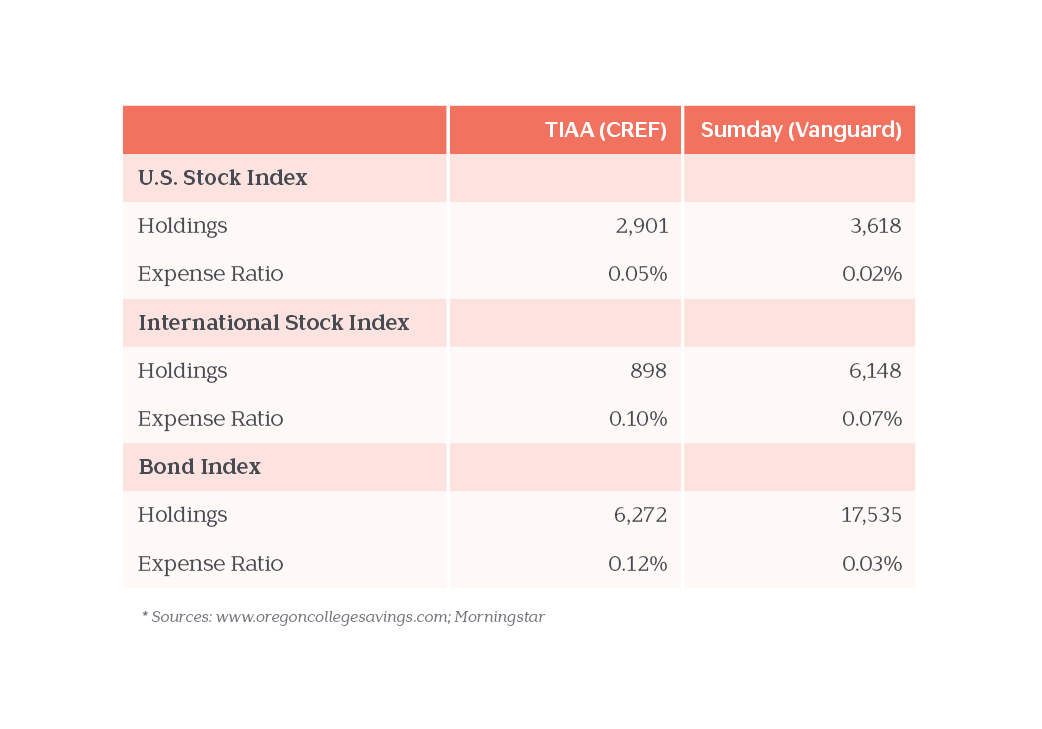
A: Yes—for the better. Sumday will give plan participants access to previously unavailable DFA funds and Vanguard index funds.

This is a big win for investors. Vanguard offers greater diversification and lower costs across domestic stocks, international stocks, and bonds.
Q: I currently have an age-based Oregon 529 plan. Will this change?

A: Yes. There is a growing trend toward nontraditional education paths. Some students take a gap year, some continue on to graduate school, and still others enter school as adults.

Because not everyone starts college at age 18 or follows the same path, Oregon’s 529 Plan is moving from age-based to target date (or “enrollment date”) portfolios.

Enrollment date portfolios allow participants to better align funds with a student’s college plans and goals.

Assets will automatically be mapped over to a target enrollment date portfolio.

Q: I have auto deposits set up. Do I need to do anything?

A: If you have auto deposits set up with your bank savings or checking account, everything automatically rolls over.

If, instead, your contributions are deducted from your paycheck, you will need to complete new paperwork that notifies your employer of the change.

Where can I go for more information?

To learn more about upcoming changes, visit Oregon’s 529 College Savings Plan FAQ or contact Vista.

Live outside of Oregon? We can also help you with questions about 529 plans across the country.

This post is Part One of a three part series on Oregon’s 529 College Savings Plan. In Part Two, we share how to withdraw funds from your plan.

Rob Greenman, CFP®

Connect with Rob


Article tags
College planningHousehold finance

Related articles
Financial planning

Investing in a career: the expanding role of the 529 college savings plan

August 27, 2026By Whit Peters

529 plans now cover more than college — trade school, apprenticeships, grad school, and professional credentials. See how the flexibility can play out in practice.

Financial planning

529 plans turn 30: still the smartest way to save for college

June 19, 2026By Rob Greenman, CFP®

Tax-free growth and consistent contributions can turn into significant college savings.

Financial planning

What The “One Big Beautiful Bill Act” Means For You

ArticleNovember 24, 2025By Jon Gannon, CFP®

This past summer, Congress passed the One Big Beautiful Bill Act (OBBBA)—an ambitious name for a law that brings something surprisingly practical: stability.

Subscribe to agenda-free news, tips, and analysis, delivered to your inbox.

This field is for validation purposes and should be left unchanged.
  • Legal Disclosures
  • Form CRS
  • Client Portal
  • Cookie Policy
  • Legal Disclosures
  • Form CRS
  • Client Portal
  • Cookie Policy
  • Legal Disclosures
  • Form CRS
  • Client Portal
  • Cookie Policy
Contact us
© Vista Capital Partners 2026. 100% employee-owned.
Manage Consent

We use cookies to track website performance. View our Privacy Policy for details.

Functional Always active
The technical storage or access is strictly necessary for the legitimate purpose of enabling the use of a specific service explicitly requested by the subscriber or user, or for the sole purpose of carrying out the transmission of a communication over an electronic communications network.
Preferences
The technical storage or access is necessary for the legitimate purpose of storing preferences that are not requested by the subscriber or user.
Statistics
The technical storage or access that is used exclusively for statistical purposes. The technical storage or access that is used exclusively for anonymous statistical purposes. Without a subpoena, voluntary compliance on the part of your Internet Service Provider, or additional records from a third party, information stored or retrieved for this purpose alone cannot usually be used to identify you.
Marketing
The technical storage or access is required to create user profiles to send advertising, or to track the user on a website or across several websites for similar marketing purposes.
  • Manage options
  • Manage services
  • Manage {vendor_count} vendors
  • Read more about these purposes
View preferences
  • {title}
  • {title}
  • {title}